Chaos Concepts
I was a co-founder of Chaos Concepts Pty Ltd. a PC computer game studio based in Redfern, Sydney. Below are a selection of articles and press releases from that time. The press kit provides a particularly interesting read. You may be surprised at some of the issues that faced game developers back then.
Entombed - Review
Mr. Bill & Lela
This classic Australian puzzle adventure game was first released as shareware, then commercially on CD in 1994, and lastly in an Enhanced CD version. The many fiendish puzzles are part of the unusual setting for a fascinating background story, and the game should keep anyone who loves puzzles engrossed for a long, long time.
You are an archaeologist looking for artifacts in a remote section of Tarsus. But when you want to investigate some ruins in a valley that the natives call ‘The Valley of Enlightenment’, your workers are afraid and won’t accompany you. Intrigued, you decide to look around alone.
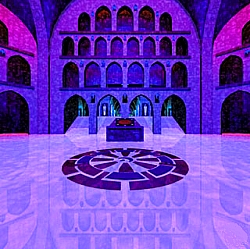
You are searching through the rubble on the floor of what looks like a temple of some sort, when you partially uncover a large unfamiliar symbol. Excited, you begin to brush away the dirt and debris. Suddenly you hear it ‘click’, like the tumblers of a lock falling into place, and the sound of doors opening. And before you even have time to react, a trap door opens under you and you find yourself falling into the depths of the earth.
You land with a thud on a cold hard stone floor. You can see light from the hole far above you and a book on a ledge. It appears to be the journal of an early explorer who disappeared in this area a century ago, and he has left the book here to help others escape.
You are in a tomb, but it is a tomb unlike any you have ever seen before. It is more like a vast underground complex, built by a very ancient race of technologically advanced humans for some unknown purpose…..perhaps the ’enlightenment’ that the natives whisper of.
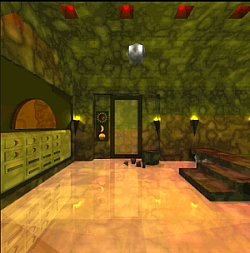
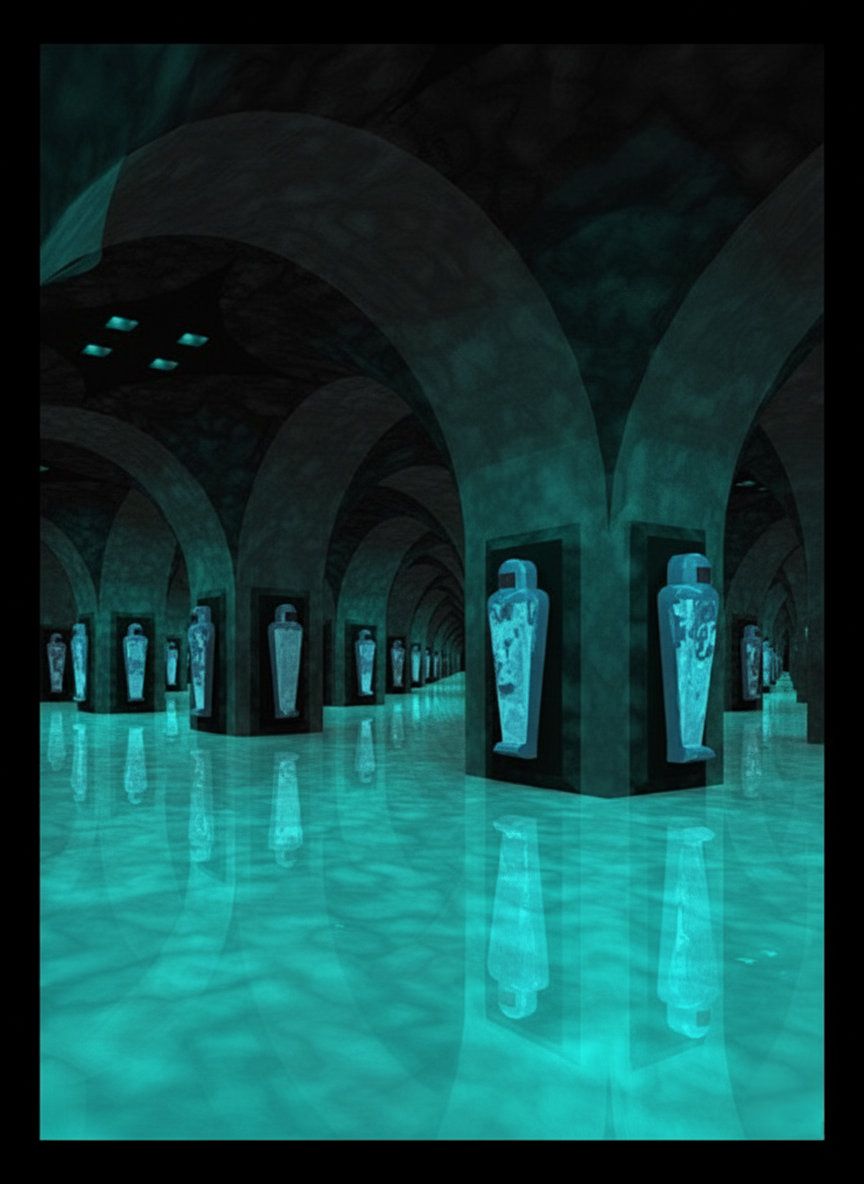
The many chambers and hugh rooms spread out over 5 different levels with strange artifacts, symbols and machines. It is beautiful and pristine, the sealed environment untouched by the dust of centuries, with shiny marble floors, strange pools, soaring archways and even what looks like a cathedral.
What did they use it for? And why safeguard it so carefully from intruders? Where did they all go when they suddenly disappeared? And more importantly, will you now choose to find your way out…..or to do what they did? Do you dare to disturb the eternal rest of the entombed?
This is a 1st person, point and click game, with inventory and an auto mapping feature. But the interface does have an unusual feature which takes a little getting used to. It includes a window that contains your 3 allotted ’lives’, your ’eye’ to give you information on objects that you examine, and ‘your other hand’(!) for doing things like holding a torch, using gloves, or joining 2 items (it is explained in the Help file).
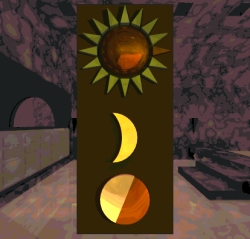
The ray-traced graphics of this surreal environment are beautifully rendered, particularly considering when the game was originally produced. The music is good and unobtrusive (but you can turn it off if desired), and the sound effects are realistic.
But both the plot and the setting served only as a device to develop the many unusual and challenging puzzles. You are pitted against an ancient civilization’s technology, and it is only by using logic to discover how it all works, while at the same time avoiding their lethal traps, that you eventually find the path to escape or enlightenment. And the only clues that you have are the suggestions you find in the diary.
The puzzles range from fairly simple to downright diabolical, with one toward the end that will almost certainly require a walkthrough. They involve everything from something as simple as learning how to turn on the lights or open doors to things like machines for dimensional transference, energy fortification, time travel and matter relocation. And there is a very difficult maze (haunted by an annoying, taunting spirit) that is 5 levels deep!
We do wish that they had included more about the enlightenment at the end. But in truth this is really a puzzle game…..and as such, it is one that should challenge even the experts.
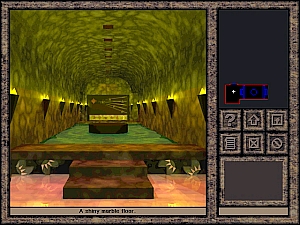
This Original Version was produced (1993-1996) by Chaos Concepts and distributed (1995-1996) by Beaucomm Interactive.
Logic behind Chaos - Interview
Rosemary Young and Gordon Aplin, Interview with Chaos Concepts (Game Star Magazine 1995)

Logic, indeed, behind the puzzles in Entombed, one of the most challenging games released last year. Its impressive ray-traced graphics and eerie sound effects together with the fiendish logic puzzles kept many of us glued to our monitors for hours on end. The creative team behind Entombed is Chaos Concepts made up of Henry Thomas and Grantley Day. We caught up with them recently to ask about their work. Here are Henry’s responses to our questions.
Game Star: How did Chaos Concepts come to be formed?
Chaos Concepts: Grantley and I just decided that we really wanted to create a game. Knowing that we had very limited resources we decided to focus on our strengths, and design a game based on what we could do well, and in a short space of time.
Game Star: So the game was Entombed. What strengths did each of you bring to it?

Chaos Concepts: At that time Grantley was very experienced at programming the Windows API in Visual Basic and Visual C++, he also had a keen knowledge of the game market with over five years experience, and most importantly loved playing games. I on the other hand was experienced in animation for film and television using computer graphics, particularly 3D, I also knew a little bit of assembly language.
Game Star: So how did the original idea for Entombed come about?
Chaos Concepts: We designed the first level one Sunday afternoon. The story was particularly important. The player’s character has fallen into a tomb, so for most of the game they are on their own. This eliminated any need for character interaction, which at the time we didn’t feel we had the resources to do. Character animation is very time consuming.
Game Star: What about those puzzles? How did you come up with them or did they just evolve?
Chaos Concepts: Puzzle’s are a very interesting challenge to create. Our knowledge of how to create a good puzzle actually evolved over the period of creating the game. To begin with we thought that each puzzle should contain a set of universally recognisable symbols. These would be placed in a discordant arrangement. To solve the puzzle some kind of mechanism needed to be altered in order to arrange the symbols in a logical sequence. But just for good measure, we would throw in some type of random element that didn’t relate to any of the symbols within the puzzle. This adds a measure of difficulty.
While this model worked, we quickly realised that people related to symbols differently, and associated different meanings to them. This meant they were unable to see any logic in the choice of some of the symbols. So we decided to add both a hint line and a journal to each puzzle in order to clarify its design and symbology.
The hint line appeared at the bottom of the screen, and displayed a brief description for whatever the mouse cursor was pointing to. The journal was this diary that the player’s character discovered when they first entered the tomb. This was written as a fictional story recounting the observations of a previous archaeologist. The journal was intended to assist the player to understand each of the puzzles, using a more structured set of deductions as the clue.
Up until level 2, all of the puzzles within the game were limited to a confined space on a wall, and their purpose was to stop the player from progressing further through the game unless the puzzle was solved. In level 2 we tried a slightly different approach. Here we designed a puzzle that required several different components to be completed before a final solution could be achieved. These solutions required the player to traverse the level, which we felt would be slightly more enjoyable because they were free to roam about. This was elaborated further in levels 4 and 5 where the player is free to traverse the entire tomb.
Level 3 had no puzzles. Instead, the layout of the rooms was designed to be a maze. What complicated matters further was that the maze was five floors deep. Although we provided an auto-mapping feature to assist the player in finding their way, the extra floors made the solution significantly more difficult.
Game Star: How long did it take you to develop this game from initial concept to finished product?
Chaos Concepts: The entire game was completed in six months. The most time consuming aspect turned out to be rendering the 3D scenes. We used a ray-tracer, and for each of the images this took between six to twelve hours.
Game Star: Why did you make Entombed a windows game?
Chaos Concepts: We chose to write for the Windows platform because we simply didn’t want to spend the time writing a DOS game from the ground up. In DOS you have to write everything yourself, video drivers, sound drivers and a memory manager. Windows on the other hand has a very sophisticated API (Application Programming Interface) with multimedia capabilities, this allows you to get on with the job of programming rather than re-inventing the wheel, yet again.
Game Star: How difficult is it to develop and sell games in Australia given the relatively small games market here?
Chaos Concepts: We have been overwhelmed by the support we have received from the Australian game playing community. Per Capita, Australia is still our most successful market for Entombed. We run a 24 hour BBS support line where people can dial in and downland the game, leave messages and ask for clue’s. People are always commenting how proud they are that Entombed was made in Australia.
Game Star: In the Arts, especially, Australians seem to have to go overseas to establish themselves, is there similar pressure in the software industry?
Chaos Concepts: One of the really nice things about entertainment software development is that it is fairly independent of national borders. While US publishers dominate the distribution, many people would be surprised to know that many of the software development teams are set up all over the globe. Consequently there is very little pressure to go and live in America, because you can write games where ever you like.
Game Star: How hard is it to crack the international market?
Chaos Concepts: We didn’t find it that hard to crack, our product stood out on it’s own. I think that in order to create a good game you need to have a small team of hard working, dedicated, multi-disciplined and exceptionally talented people. But that’s not all, you also have to know the market well, and have someone like Grantley who just lives for playing games. Once you have all this, then you have a winning combination.
Game Star: The federal government has announced the Creative Nation Initiatives to promote the development of multimedia software in Australia, do you see thisinitiative having any benefit for the electronic entertainment industry?*
Chaos Concepts: We have been trying to understand who the Creative Nation Initiatives is intended for and what it will achieve for some time. Personally I think that it will become just another self serving federal government bureaucracy that will invest in products that have questionable market potential. While these productions may develop a skills infrastructure for the multimedia industry, I doubt if these productions will nurture competitive and efficient work practices. If the film industry is anything to go by, I fear that computer graphic artists and multimedia programmers of dubious talent may yet exceed actors in the ranks of the unemployed.
Game Star: Besides the sequel to Entombed, are you working on any other projects?
Chaos Concepts: Since Entombed, Chaos Concepts has headed down the aggressive road of expansion. Already we have set up another two teams of four people who are working in tandem with us on various projects. While the ideas and titles for these games are still under wraps, we can at least paint some broader brush strokes. One of the teams is working on a futuristic role playing adventure. The artwork is absolutely stunning. The game will look like a comic book that has come to life. Team two has a video production background and is working on a multimedia CD ROM title using digitised people and 3D backgrounds. Unlike many of the other interactive movies on the market, this will be a game. There will be a strong emphasis on game play, and the tactility and responsiveness of the interface.
Grantley and I have several shareware titles that we are also working on. We have spent the past 6 months consolidating our software engineering. Our new routines hold the images being used by a game compressed in memory, reducing the overall memory requirements for the game and increasing performance. The really neat thing is that the routines are able to decompress images on the fly directly onto the screen. The routines support masking, clipping and scrolling at arcade performance levels on hi- resolution images. We are also close to finishing a new 3D engine that will support hi-resolution hardware page flipping for smooth scrolling animation under Windows.
Entombed - Reviewers Guide
CHAOS CONCEPTS LAUNCHES THERE NEW GAME ENTOMBED IN AUSTRALIA
ENTERTAINMENT SOFTWARE announcement.
For release in April, 1994
SYDNEY – Entombed is the latest game designed and created by Chaos Concepts, a new Australian entertainment software company based in Sydney. Entombed will be published internationally by the US company Software Creations. Due for release in April, Entombed boasts a 640 x 480 hi-res game interface, breath taking ray traced graphics, digital audio and five intricate levels.
Philosophy
Chaos Concepts may be a new face in the crowd, but it’s designers have been kicking around in the entertainment software industry for some time. Drawing on there experience, Chaos Concepts is commitment to bring our you exciting Windows games with outstanding features;
- Strong plots
- Exceptional graphics and sound
- Affordable pricing
- System compatibility
- Free technical support
Overview
Entombed is the ULTIMATE PUZZLE ADVENTURE where you play the role of an archaeologist who becomes trapped in an ancient tomb. Alone you must navigate your way through deadly traps, intricate puzzles and involved mazes, as you try to escape from this harsh captor, before it claims another victim.
Deciphering information from the hieroglyphic inscriptions, you will discover that the previous civilisation was highly advanced, maybe your not in a tomb after all, but a structure of more clandestine intentions. You also discover the remains of others have been here before you - Grave robbers? Fortunately you find the diary of another explorer who also became trapped in the tomb, many years ago, it proves to be invaluable in your quest to survive. So what did become of the race that created this vast underground metropolis, and what is its purpose? Communication with another realm? Time travel?
Prepare yourself for a new dimension in entertainment and design, when you enter Entombed!
The first level of Entombed will be released via Shareware, so you can download it from your local BBS. The remaining four levels will be available in Australia for $49.95 through a 24 hour order line on 1800 807 486. There will also be a CD-ROM release in May, that boasts extended graphics sequences and a multi-media help system.
With Entombed, Chaos Concepts have set a high standard of game play and system compatibility for the PC computer. Entombed runs under Windows 3.1, although looking at the game you would never know it. Because Entombed runs under Windows it is extremely compatible with most PC systems and in particular disk compression software. Essentially, if your machine runs Window then you will be able to run Entombed, with little or no changes ( all you may need to do is install a 256 colour driver!). The system requirements to run Entombed are 2 Megabytes of ram, a 386 PC, a 512k Super VGA display and a mouse. A wave and midi audio card is also strongly recommended.
Positioning
Over the past year we have spent a great deal of time researching our users, and studying trends in the PC entertainment industry.
Windows now has 40 million users world wide, many of whom find it difficult to play PC games because of problems with Windows incompatibility and the constant need to modify the system’s startup configuration. Despite this, to this date, there are only a hand full of commercially released windows adventure games.
With all of the hype surrounding games like Wolfenstine 3D and Doom, most of the major software entertainment developers, including Westwood, Origin and SSI are frantically developing similar 3D - first person perspective - low resolution graphics engines for their own adventure game series.
Although this may be eagerly anticipated by some, it is also creating a widening community of disaffected game players who long for the traditional phased time game play that doesn’t require the wrist -eye coordination of these newer arcade style adventures.
With, Entombed, Chaos Concepts believes it has addressed many of these concerns. Entombed was originally released late last year, and sense then we have had a lot of feed back from game players all around the world. This has allowed us to create a profile of our users, and refine our products to meet their needs.
Don’t get stuck with a lemon
Chaos Concepts, believe entertainment software prices are too high. Our research indicates that current game prices are in excess of what most PC game players are prepared to spend.
In fear of spending good money on a lousy game, many pirate software before they buy it to try it out. They also jointly buy entertainment software with their friends in order to reduce the purchase cost. Some simply pirate game software because they can’t afford to buy all the games that they would like to play. Because of this we decided to let game players try out our games as shareware, free of charge.
The significance of a shareware release is not to be underestimated. In the traditional retail market, even a poor quality game with a good box will sell. In the shareware market, only a good game will sell, so good design, graphics and game play are what really matter.
To ensure that Entombed met this challenge, we released the first version locally late last year. Since then we have had over 250 players contact our BBS for hints. We monitored there comments in questionaries and watched closely the type of hints that they required. Because of this we have been able to refine Entombed and added many new features to it. The new shareware release of Entombed has evolved considerably.
Compatibility and Support
To this day, Chaos Concepts BBS has only received one technical support call. This was a problem encountered with an older Ati Mach 32 driver - the solution was simply to download the newer drivers from our BBS. Because of this we are very proud of just how compatible Entombed is. Essentially if Windows works, and you have a 256 colour display driver installed then you can play Entombed straight away. Unlike many other game programs, Entombed will work with DISK COMPRESSION software, network drives, and any Windows memory configuration.
Chaos Concepts believes in good product support, our bulletin board always has the most recent versions of all our shareware on it, free for downloading, it also has bug fixes and most Windows display and sound drivers. It only exists to support Chaos Concepts software and is available twenty-four hours a day. The protocol is 1200, 2400 baud, or 9600 baud v.32bis, eight data bits, no parity and one stop bit.
Feature Comparison
One of the first things you will notice about Entombed is the quality of our graphics. All of which have been pain stakingly ray-traced. Some images required up to 12 hours to render. But the wait is definitely worth it! You may be interested in some of the technical differences between Entombed and other Windows games, so we thought we would take this opportunity to draw your attention to them.
Entombed
- All images are ray-traced using Vivid 386. This allows recursive reflections, particularly noticed on the floors.
- The multiple light sources cast shadows and create a rich pattern of light and shade that give the images their definition.
- Chaos maths is used to create detailed material textures including marbles, gold, chrome and water.
- Each image has a separate palette and is NOT dithered. This gives them a sharp rich level of detail and added graphics performance through higher compression levels.
- Entombed was written in C++ and interfaces directly with the Windows API for maximum performance.
Critical Path, The Journey Man, Iron Helix, Quantum Gate.
- All images were phong shaded in programs like Electric Image and 3D Studio.
- Reflections have a limited recursion depth and poor accuracy which leads to a level of flatness.
- Glass objects do not refract light rays and light sources have a linier rolloff.
- Multiple light sources are rendered without shadows, as only a limited number of spot lights are able to cast shadows. This creates a lack of tonal depth and adds to the image flatness.
- Material textures are created using bitmapped image wrapping.
- All images are dithered to a single, common system palette, or in the case of Quantum Gate require the system to have a 32 bit graphics card.
- These games are all very system intensive, some requiring at least 8 mb of system ram.
- Some of these programs were written in interpretive multi-media scripting languages like Macromind Directors LINGO, or Visual basic as in the case of Critical Path. None of which create code that performs at the machine language level.